The Neighbours: What Else Lives Where Our Cinnamon Grows
Monkeys eat young cinnamon plants and new plantings need protecting. In the reserve above the farm, mixed bird flocks have been studied since 1981.
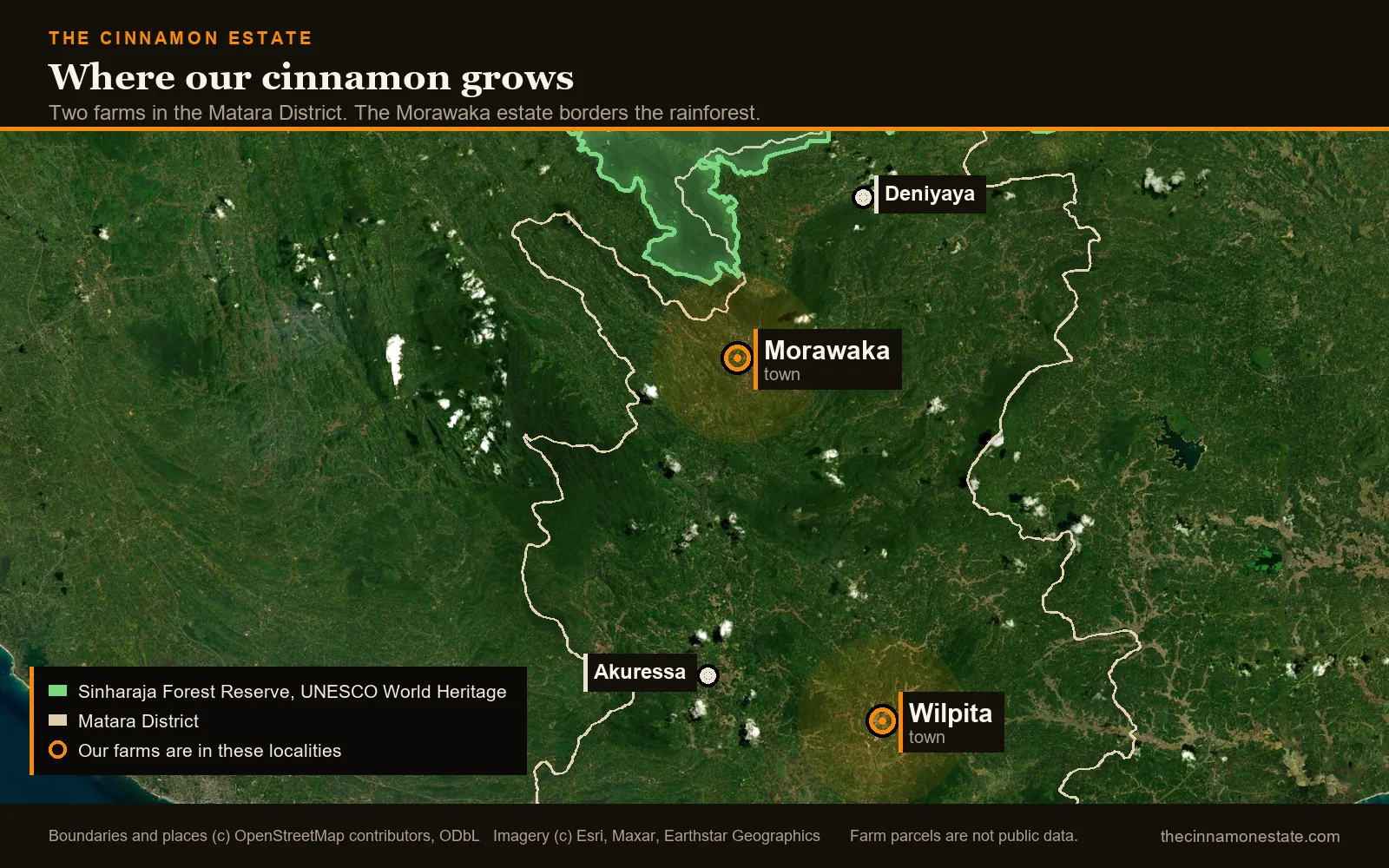
We have written about Morawaka and Wilpita. This is about what else lives around them.
Animals on the land
Our estate at Morawaka borders the Sinharaja reserve, so animals come onto the plantation from the forest. Monkeys are the regular ones, and there are birds on the plantation all day.
Young cinnamon gets eaten. The plants are soft for the first year or two, so new sections need protecting until the stems harden. Older plants can look after themselves.
We do not fence the forest out. You could not, and it would be the wrong thing to do anyway.
The bird wave
The birds in the forest above Morawaka are unusual, and people have been studying them there for a long time.
They move in mixed flocks, lots of species travelling together through the trees. Inside the reserve, researchers have followed these flocks continuously since 1981, which makes them the longest-studied mixed flocks in the world. An average one holds about 41 birds from about 12 species, usually led by the Sri Lanka drongo and the orange-billed babbler (Birdingplaces).
That work is done in the forest, not over our plantation. What reaches the farm is whatever flies out of it.
Sri Lanka has twenty rainforest birds that live in no other country, and nineteen of them have been recorded in the reserve. Two, the Sri Lanka blue magpie and the red-faced malkoha, are hard to see even if you go looking.
The rest of it
The Forest Department has recorded 270 vertebrate species in Sinharaja, and 60 of those live only in Sri Lanka. That includes 8 of the 39 mammals, 10 of the 20 amphibians and 21 of the 72 reptiles. Butterflies are counted separately, and 21 of the 65 species there are endemic (UNESCO).
The animal most visitors actually see is the purple-faced leaf monkey. It is endemic and it does not mind being watched.
What it changes
Farming against a forest changes what you plant and how you cut.
Cinnamon works well here. It is a tree, not an annual crop. It is coppiced, so the stem is cut and the plant grows back from the same root instead of being cleared and replanted. The roots hold the hillside, which matters on ground that gets this much rain.
We are not certified as anything and we are not calling this conservation. It is just how the crop works.
We sell direct from these two farms, with no line of buyers and exporters in between, so we would rather describe the place properly than leave you guessing at it.
Sources: Sinharaja Forest Reserve, UNESCO · Sinharaja Forest, Birdingplaces
Map data © OpenStreetMap contributors, ODbL. Satellite imagery © Esri.
Taste the difference for yourself
Real Ceylon cinnamon, grown and hand-rolled on our family estate in Sri Lanka.
Shop the estate