Where Our Farm Ends, the Rainforest Begins
Follow the road up from the coast and the forest becomes the fence. This is Morawaka, where our cinnamon grows on the edge of the Sinharaja rainforest.
If you drove to our cinnamon from the coast, you would leave the sea at Matara and head inland.
The road goes through Akuressa, then Morawaka, then Deniyaya, and the land rises the whole way. About two buses an hour make the trip from Matara (Wikipedia). Our first farm is at Morawaka, and it is the one that runs up against the rainforest.
The road up
Akuressa comes first, about 24 kilometres from the coast (Wikipedia). It is low country, with tea, coconut, rubber and rice around it.
Our grandfather had his business in Akuressa. He was one of the better known businessmen in the town in his day, and around 1948 he bought the cinnamon estates our family still works. That is the year on our seal.
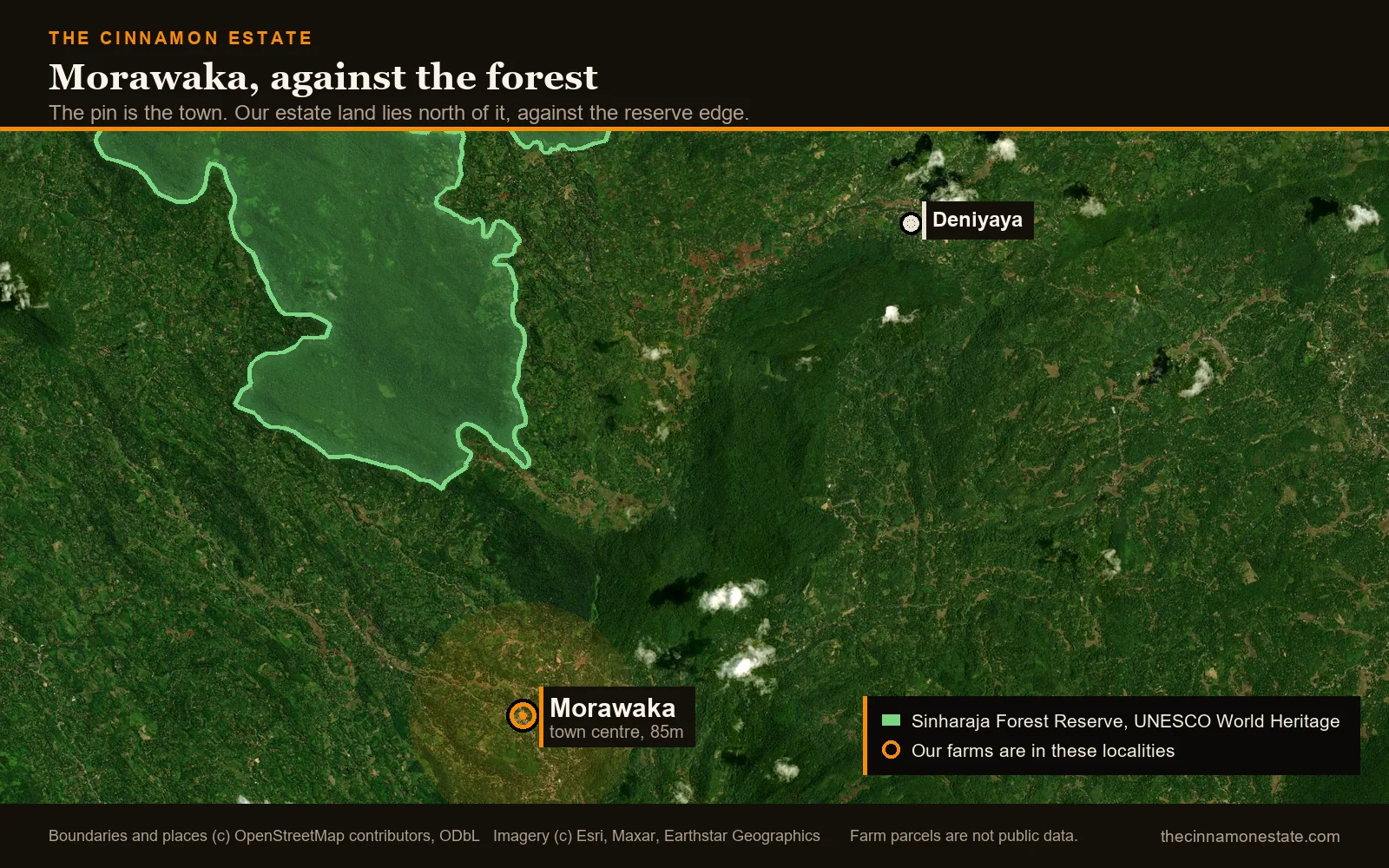
Morawaka is further up the same road. It sits at 85 metres, where the road from Akuressa to Deniyaya meets the B363 (Wikipedia). By now Galle is about 65 kilometres behind you and Colombo about 144. People here grow tea and rice, and there are said to be gems in the ground.
Keep going and the road climbs to Deniyaya, at 450 metres. That is where visitors stay when they come to walk in the forest (Wikipedia). Morawaka, below it, is a farming town.
The forest
North of Morawaka the land keeps rising, and it ends in the Sinharaja Forest Reserve.
Sinharaja has been a UNESCO World Heritage site since 1988 (Wikipedia). UNESCO calls it the last viable area of primary tropical rainforest in Sri Lanka, and its listing covers about 8,864 hectares (UNESCO). It lies across three districts (Wikipedia). More than 60 per cent of the trees there grow nowhere else in the world. Sri Lanka has twenty birds found in no other country, and nineteen of them have been recorded inside the reserve.
On the map above, the green line is the reserve boundary as OpenStreetMap has it. Measured on that line, the forest edge is about four kilometres from the middle of town. Our land is north of the town, on the forest side, and it runs up to that edge.
Living next to it
Animals come out of the forest and onto the plantation. Monkeys are the usual ones, and there are birds on the land all day.
Young cinnamon is soft. The plants are easy eating for the first year or two, so every new section needs protecting until the stems harden. Older plants look after themselves. It is extra work in every planting season, and we have decided we can live with it.
The other thing about this side of the hills is the rain. Morawaka is in the wet zone, the side of the island that catches the south-west monsoon. Bark peels cleanly off a tree that is full of water, and it tears off a dry one. So the peeling weeks follow the weather rather than a date on a calendar. Some years that is inconvenient. It is still the only way the bark comes off in one sheet, which is what a rolled Ceylon cinnamon quill is made from.
What we want for this place
We want the people who work this land to earn well enough that a desk job in the city stops looking like the better life. That is the whole reason we sell direct instead of through a line of buyers and exporters. Every order that comes straight to the farm keeps more of the price in Morawaka, and Morawaka is where the clinic, the school fees and the long-term jobs are.
You can look the place up before you order. The town is on any map, the reserve line is on OpenStreetMap, and Akuressa, where our grandfather had his business, is on the road in from the coast.
Our second farm is at Wilpita, lower down and drier. That one is next in this series.
Sources: Morawaka, Wikipedia · Akuressa, Wikipedia · Deniyaya, Wikipedia · Sinharaja Forest Reserve, Wikipedia · Sinharaja Forest Reserve, UNESCO
Map data © OpenStreetMap contributors, ODbL. Satellite imagery © Esri.
Taste the difference for yourself
Real Ceylon cinnamon, grown and hand-rolled on our family estate in Sri Lanka.
Shop the estate