How a Ceylon Cinnamon Quill Is Made, by Hand
A quill is not cut from a tree. It is peeled, scraped, rubbed and rolled by hand. Here is how Ceylon cinnamon is really made, and why machines cannot do it.
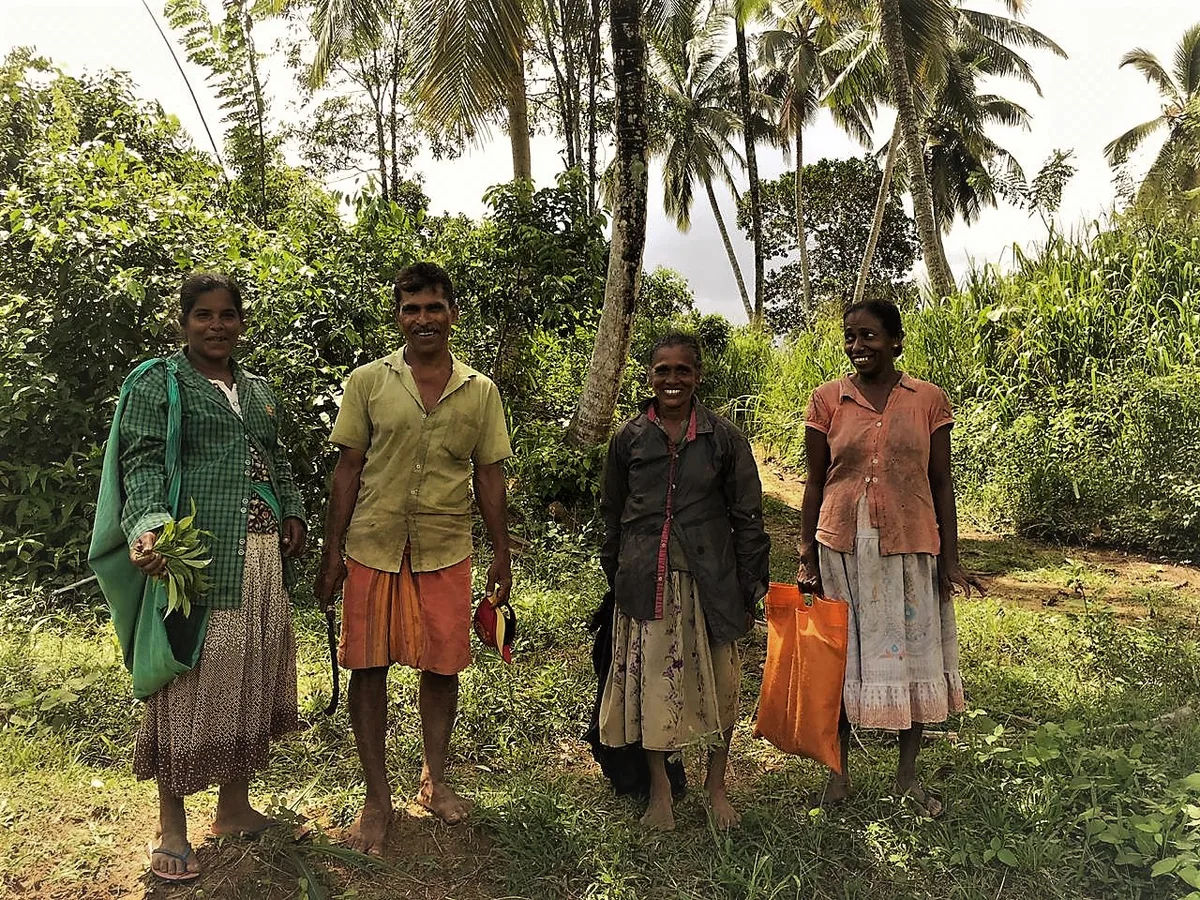
Most people picture a cinnamon stick being cut from a tree, the way you might cut a length of dowel. It does not happen like that at all. A quill is built, not cut. Somebody peels the inner bark off a young shoot in one long sheet, then rolls those sheets into a tube by hand, one inside the other, and lets it dry until it holds its shape.
It is one of the last spices in the world still made this way. Once you know what happens in a peeling shed, the stick in your jar looks completely different.
It begins with a shoot, not a trunk
True Ceylon cinnamon comes from Cinnamomum verum, and Sri Lanka still grows the overwhelming majority of the world’s supply of it (Wikipedia). The plants are not left to grow into timber. They are coppiced, which means they are cut back low so they send up a thicket of slim new shoots, and it is those shoots that get harvested.
Bark is taken twice a year, just after each monsoon, and a young planting is usually ready for its first harvest about three years in (Sri Lanka Export Development Board). The timing is not sentimental. Sap is moving through the stem in the wet months, and a stem with sap running gives up its bark willingly (The Sunday Times). Cut in a dry spell and the same bark clings on and tears.
The cut shoots go to the peeling shed the same day, because the bark is easiest to work while it is still fresh.
Scraping and rubbing, the part nobody photographs
The first jobs look like preparation, but they are most of the craft.
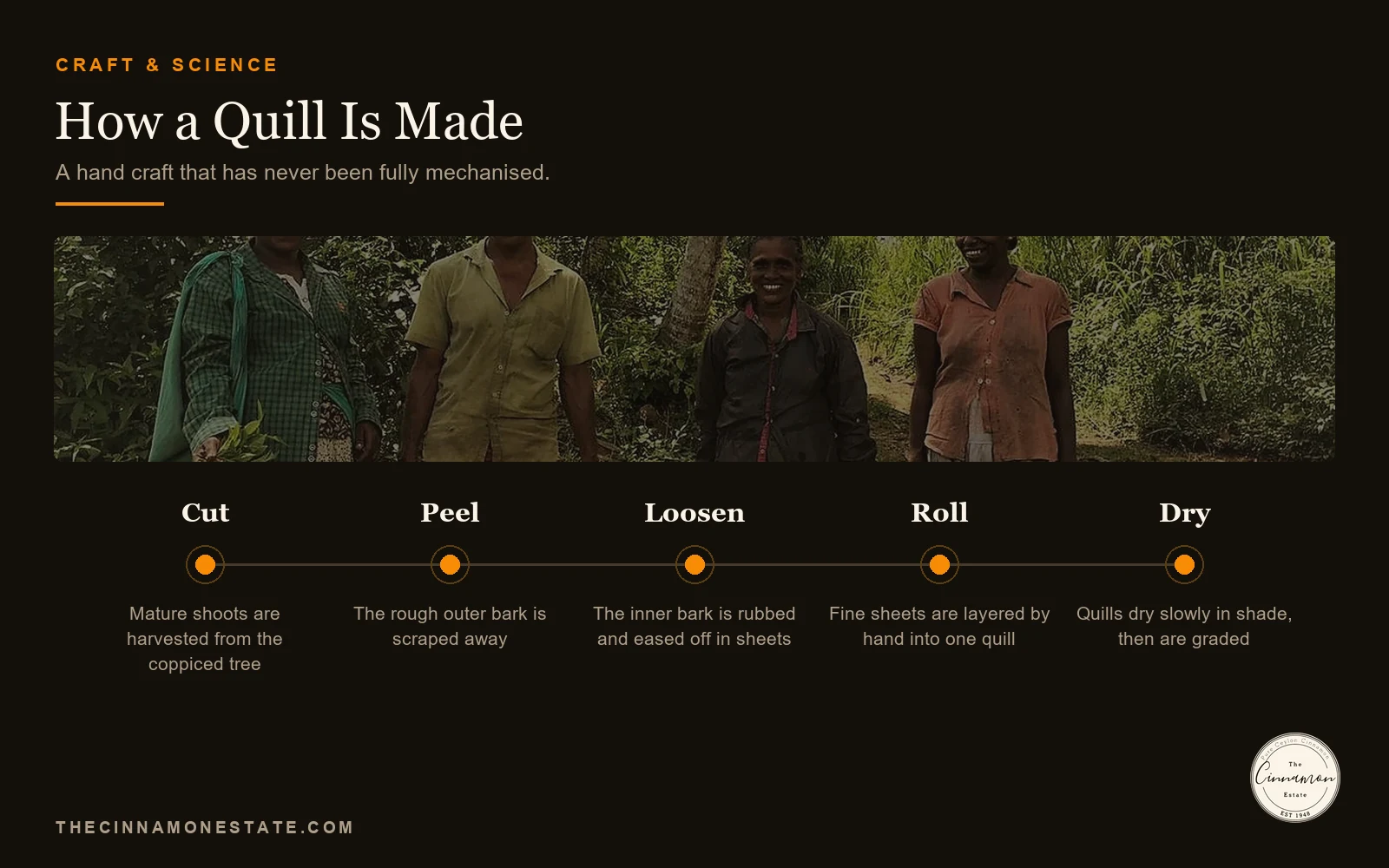
Knots and side twigs come off with a small curved knife the peelers call a kethta. Then the rough, corky outer bark is scraped away with a hooked tool, the kokethta, until the smooth layer underneath is showing (The Sunday Times). Scrape too lightly and the outer bark stays behind and dulls the flavour. Scrape too hard and you are into the good bark, which is thinner than a business card.
Next comes the rubbing. The peeler works the stem over with a brass rod, firmly and repeatedly, until the inner bark loosens from the hard wood underneath (Sri Lanka Export Development Board). You can see when it is ready because sap starts to bead on the surface (The Sunday Times). There is no gauge for this and no timer. The peeler feels the bark give, and stops.
Lifting the bark in one piece
Now comes the peel itself. Two parallel slits are run down the length of the stem with a fine pointed knife, and the soft inner layer is worked free and lifted off in a single sheet (Sri Lanka Export Development Board).
A good peeler reads the stem first and decides where to cut so the sheets come off as long as possible. Every tear costs length and value, so the job is a quiet argument between speed and care.
Building the quill
Here is the part that surprises people most. A quill is not one piece of bark curled up. It is several.
The sheets are laid one inside the other and overlapped end to end, so the tube grows longer as the peeler works, and the hollow in the middle gets packed with smaller offcuts of the same inner bark (Sri Lanka Export Development Board). The Sri Lankan standard for a full quill runs to a little over a metre in length, which is why the long bundles you see in a Colombo warehouse look more like kindling than kitchen spice (Study and Master Plan for the Ceylon Cinnamon Value Chain). What reaches your kitchen has been cut down from one of those.
The finished tubes rest for about a day, then dry on racks under shade for another four to seven days, tightening as they go and turning the pale golden brown you know (Sri Lanka Export Development Board). Along the way they get rolled on a flat surface so the outside smooths off. Then they are graded, trimmed and bundled.
Why no machine has taken this over
People have tried to mechanise it. The problem is that every shoot is a slightly different thickness, with the bark loose in one section and tight in the next, and the peeler is making dozens of small judgements a minute that nobody has managed to write down as a rule.
So it stays handwork, and that has become the industry’s real worry. Experienced peelers are getting harder to find as younger people take steadier work elsewhere, and Sri Lankan reporting has put the number of active peelers well below what the planted area actually needs (Al Jazeera, Adaderana Biz). Training academies now exist precisely because the skill takes years to build and cannot be rushed.
That is the honest reason good Ceylon cinnamon costs what it does. You are paying for a person’s hands and a person’s judgement, twice a year, shoot by shoot.
Our family grows and rolls ours on our own estate in Sri Lanka, never fumigated, sold direct so the growers keep a fairer share. Next time you drop a Ceylon cinnamon stick into a pot, or spoon out some true Ceylon cinnamon powder, have a proper look at it first. You can still see where the sheets overlap.
Sources: Sri Lanka Export Development Board: Processing of Ceylon Cinnamon · The Sunday Times Sri Lanka: peeling practices · Al Jazeera: Harvesting ‘true cinnamon’ · Study and Master Plan for the Ceylon Cinnamon Value Chain (STDF) · Wikipedia: Cinnamomum verum · Adaderana Biz: labour shortage in the cinnamon industry
Taste the difference for yourself
Real Ceylon cinnamon, grown and hand-rolled on our family estate in Sri Lanka.
Shop the estate