The District Our Cinnamon Comes From
Both our farms are in the Matara District in the south of Sri Lanka. Tea, rice, rubber and cinnamon, mostly grown by smallholders.
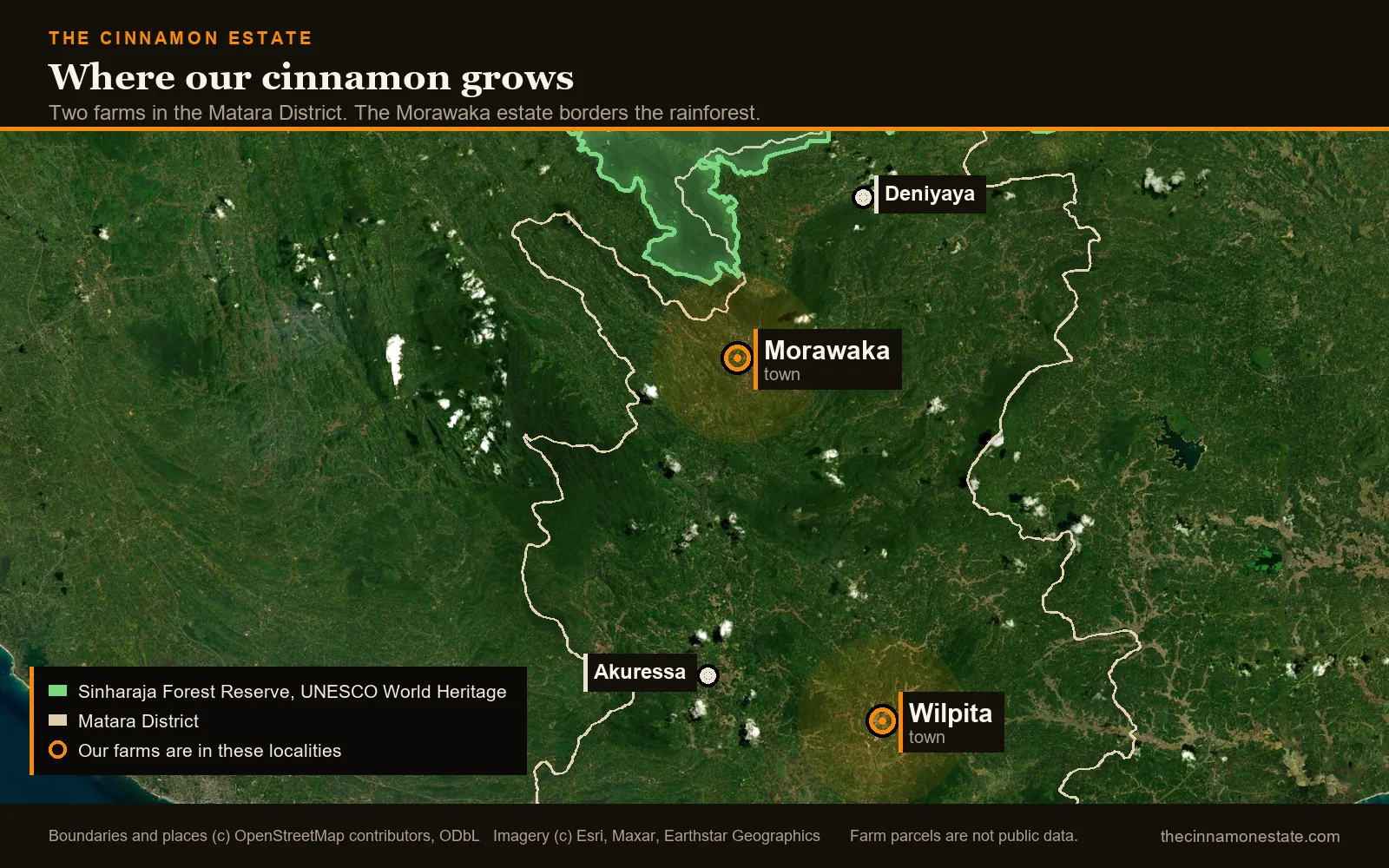
Both our farms are in the Matara District, in the south of Sri Lanka. This is what the district is actually like.
The wet zone
Matara District runs from the coast up into the hills. It is in the wet zone, the side of the island that catches the south-west monsoon.
That is why cinnamon does well here. Bark peels clean off a wet tree and tears off a dry one, so the cutting follows the rain rather than a schedule.
Matara town is on the coast at the mouth of the Nilwala River (Britannica). Going inland the land rises slowly through Akuressa, then more steeply toward Morawaka and Deniyaya, then into forest.
What people grow
The district grows tea and rice, along with rubber, coconut and cinnamon.
Morawaka is known for tea and rice, and for gems (Wikipedia). Matara town is the trading centre for the region and had a population of just over 74,000 at the 2012 census (Britannica).
Most cinnamon in Sri Lanka does not come from big estates. It comes from smallholders, tens of thousands of them, on small plots. That is why peeling skill is so common here, and why the money is so easy to lose on the way out.
Why we name the place
When a spice has no address, it gets bought and sold as though nobody in particular grew it.
Wilpita and Morawaka are real places on a map, in a district with a river, a census and two old forts. They are not a marketing region.
We sell direct from those two farms. Otherwise the spice goes through five or six sets of hands and the grower ends up furthest from the money. Shortening that is the whole business. What it pays for is long-term work instead of seasonal labour, a free clinic on the estate, and schooling and clothes for the children.
What we cannot do yet
We would like to publish a number.
Some direct trade companies state exactly what they pay their farmers against the market price. It is the most convincing thing on their websites because you can check it.
We have said we want 60 per cent of profit going back to the growers and the land. That is a goal, not a finished job, and we have said so on this site before.
Until we can publish that figure, the district and the two farms are what we can put our name to.
Sources: Matara, Britannica · Morawaka, Wikipedia
Map data © OpenStreetMap contributors, ODbL. Satellite imagery © Esri.
Taste the difference for yourself
Real Ceylon cinnamon, grown and hand-rolled on our family estate in Sri Lanka.
Shop the estate